
What does the Project Workflow consist of?
Lecture 9

A project workflow is a series of interconnected steps or stages that a project team follows to complete a project. It outlines the activities, tasks, and deliverables required to achieve the project goals within a defined timeline and budget. The project workflow provides a framework for organizing and managing the work required to complete the project and ensures that everyone involved is aware of their responsibilities and deadlines.
Example:
Creation of a SaaS Product
Writing the code for the program
Doing a QA (Quality Assurance) of the written code
Implementing the code for beta testing
What is not a workflow?
Writing code for the program
Writing a blog post for a knowledge base of the product
For a workflow, the steps need to be sequential but interconnected.
Project Management Workflow vs. Project lifecycle
Project workflow and life cycle are related concepts in project management, but they are different. The main difference between the two is that the project life cycle represents the stages or phases a project goes through. In contrast, the project workflow represents the sequence of activities and tasks the project team follows to complete a project. The project life cycle provides a high-level overview of the project stages. In contrast, the project workflow provides a detailed view of the activities and tasks the project team must perform to move the project through each stage of the project life cycle.
For example, in the project life cycle planning stage, the project workflow might include defining the project scope, creating a work breakdown structure, and identifying project risks.
Project workflow IT Example
A project workflow for developing a web-based e-commerce platform may include the following steps within each stage of the project life cycle:
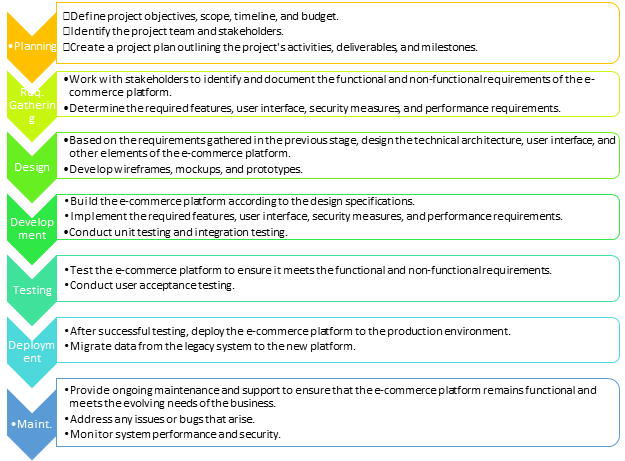
This workflow can be adapted to suit the project’s specific requirements and can be managed using different methodologies such as Agile, Waterfall, and Hybrid. By following this workflow, the project team can deliver a successful e-commerce platform that meets the needs of the business and stakeholders.
Advantages of Project Workflows
There are several advantages of having a project workflow, including:
Improved efficiency: A project workflow provides a structured approach to managing a project, ensuring everyone knows their responsibilities and deadlines. This helps to streamline the project and improve efficiency, reducing the likelihood of delays and missed deadlines.
Better communication and collaboration: A project workflow promotes better communication and collaboration among team members and stakeholders, ensuring that everyone is aware of the project status, issues, and risks. This helps avoid misunderstandings and ensures everyone is working towards the same goals.
Greater transparency: A project workflow provides greater transparency into the project, making it easier to track progress and identify issues. This helps project managers to make informed decisions about resource allocation and risk management.
Improved quality: A project workflow includes quality control activities, such as testing and review, which help to ensure that the project meets the functional and non-functional requirements specified in the project plan.
Increased agility: A project workflow can be adapted to suit the specific requirements of each project, and different methodologies such as Agile, Waterfall, and Hybrid can be used to manage the workflow. This helps to ensure that the project team can quickly adapt to changing requirements and deliver a successful outcome.
Conclusion
In summary, a project workflow provides a structured approach to managing a project, promoting better communication and collaboration, improving efficiency, transparency, and quality, and increasing agility. These advantages help to ensure that the project team can deliver a successful outcome that meets the needs of the business and stakeholders.